Cold storage facilities can play a critical but often underappreciated role in the global food supply chain. From fresh produce and protein products to frozen and prepared foods, cold storage enables food to move efficiently, safely, and reliably from producers to end consumers.
Essential infrastructure within the global food supply chain - Cold storage facilities play a critical role in preserving and distributing food, supporting reliable, necessity-driven demand tied to how food is produced and consumed.
Specialized assets with high barriers to entry - Temperature-controlled environments, energy intensity, and operational complexity create meaningful construction and operational barriers relative to traditional industrial real estate.
High tenant reliance supporting long-duration occupancy - Facilities are deeply embedded within distribution networks and costly to replicate or relocate, contributing to longer tenant tenures and alignment with long-term leasing structures.
Demand driven by structural, non-discretionary trends - Population growth, evolving diets, and the rise of grocery e-commerce continue to increase the need for temperature-controlled logistics infrastructure across the food supply chain.
As population growth, evolving consumption patterns, and the rise of grocery e-commerce reshape how food is produced and distributed, demand for specialized, temperature-controlled logistics infrastructure has increased.1 Unlike traditional industrial real estate, cold storage assets are highly customized, capital-intensive, and operationally complex, reflecting characteristics that create meaningful barriers to entry and high switching costs for tenants.2
These same attributes, we believe, can make cold storage particularly well suited to a net lease real estate framework. Facilities are mission- critical to tenant operations, deeply embedded within distribution networks, and costly to replicate or relocate. As a result, tenants often prioritize long-term occupancy and are willing to commit to extended lease terms, particularly in newer vintage assets that offer superior energy efficiency, automation, and operating cost advantages over aging infrastructure.2
Cold storage combines the characteristics of industrial real estate with the economics of essential infrastructure.
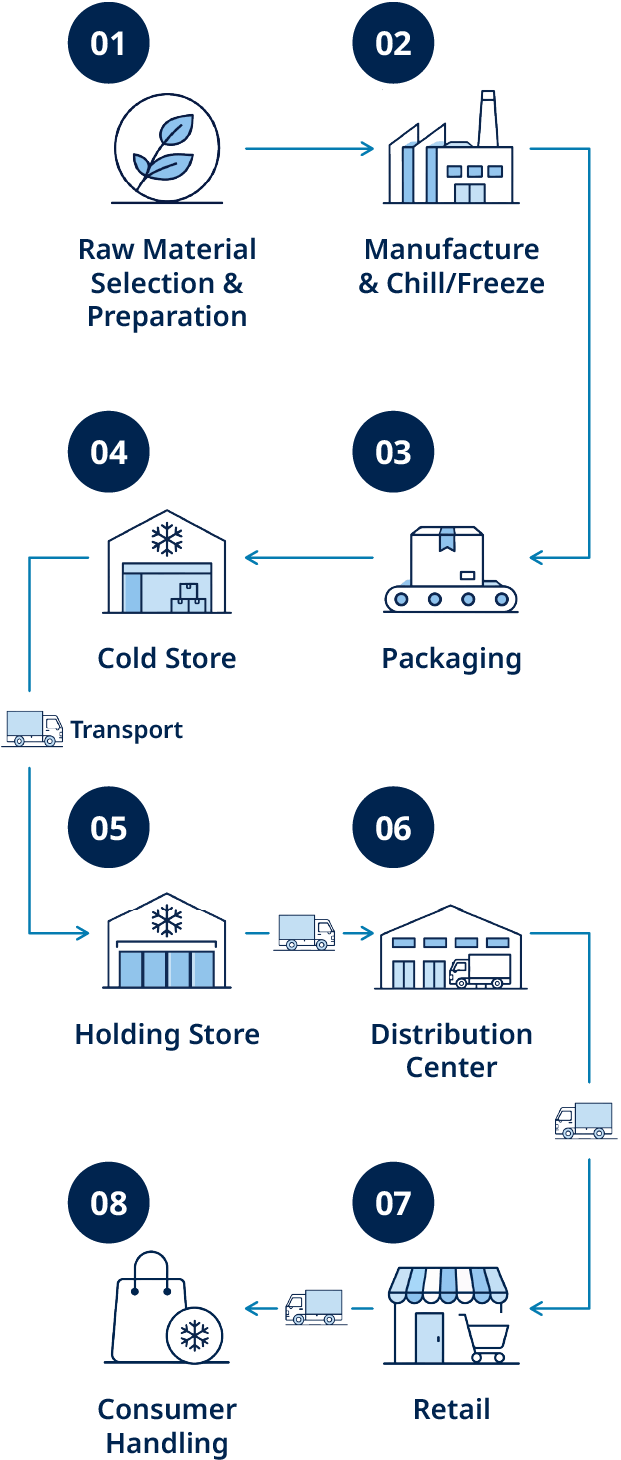
Cold storage facilities are embedded at multiple points across the supply chain, supporting the safe and efficient movement of food from origin to end consumer.
Key differentiators include:
High capital intensity driven by refrigeration, automations, and energy needs.
Operational complexity tied to food safety and throughout requirements.
High switching costs, as facilities are deeply embedded in distribution networks.
While cold storage facilities may resemble traditional industrial warehouses, they operate as highly specialized infrastructure assets with distinct economic and leasing characteristics.
Cold storage facilities require controlled—and often sub-zero—environments supported by specialized insulation, refrigeration systems, and power infrastructure. These requirements materially increase construction costs and operating complexity relative to conventional industrial assets, making facility design and efficiency central to tenant economics.
U.S. cold storage is a specialized sector representing less than 2% of the overall industrial market, yet it is mission- critical infrastructure for U.S. consumption.3 Today, the property type is in a period of generational change driven by advancements in technology, resulting in elevated development activity and greater dispersion across assets. Modern, well-located facilities continue to demonstrate stronger operating performance, reinforcing the importance of asset quality and long-term positioning. Newer vintage assets have generally demonstrated stronger operating characteristics relative to older stock due to:

Superior energy efficiency

Automation readiness

Lower operation costs and higher throughput
These dynamics support longer tenant tenures and align closely with long-duration net lease structures.
Cold storage demand is driven less by discretionary consumer spending and more by how food is produced, distributed, and consumed, reflecting factors that tend to be more resilient across economic cycles.
Key long-term demand drivers include:
Population growth and evolving diets, supporting fresh and frozen food demand.
Grocery e-commerce and food delivery, increasing the need for temperature-controlled logistics
Rising food safety standards and labor constrains, accelerating automation and reinvestment
Together, these trends position cold storage as necessity-driven, mission-critical infrastructure, well suited to net lease real estate strategies focused on durable occupancy and long-term cash flow visibility.
Cold storage operators face significant capital demands, particularly as facilities become more automated and energy intensive. Net lease structures, especially build-to- suit and sale-leaseback transactions, have become important tools for supporting tenant growth by:
Financing construction and specialized capex
Preserving tenant operating cash flow
Supporting long-term occupancy of mission-critical facilities
From an investment perspective, cold storage sits at the intersection of industrial real estate and essential infrastructure and may appeal to investors seeking:
Mission-critical assets with high tenant reliance
Long-duration leases supported by high switching costs
Cash flow durability tied to essential economic activity
While assets are purpose-built, modern cold storage facilities remain highly sought after across the food supply chain, supporting long-term value and re-tenanting optionality.
Viewed through this lens, we believe cold storage represents, for investors, a specialized but highly compelling extension of net lease real estate investing, that may support income durability.
Modern, well-located facilities with efficient designs
Assets priced below replacement cost
Long-term investors able to underwrite complexity and partner with tenants
For net lease investors, this environment has created improved entry points into a sector with strong long-term fundamentals.
Cold storage real estate sits at the intersection of industrial logistics and essential infrastructure. Demand is shaped by how food is produced, distributed, and consumed, while supply is constrained by the specialized requirements of temperature-controlled facilities.
These dynamics support tenant reliance, long-duration occupancy, and alignment with net lease structures, positioning cold storage as a differentiated segment within real assets that may offer durable income characteristics over time.
Your go-to for an owl’s-eye view on what matters most to us in Private Wealth.
Endnotes
Important information
Unless otherwise noted the Report Date referenced herein is as of March 31, 2026.
Past performance is not a guarantee of future results.
The material presented is proprietary information regarding Blue Owl Capital Inc. (“Blue Owl”), its affiliates and investment program, funds sponsored by Blue Owl, including the Blue Owl Credit, Real Assets Funds and the GP Strategic Capital Funds (collectively the “Blue Owl Funds”) as well as investment held by the Blue Owl Funds.
An investment in the Fund or other investment vehicle entails a high degree of risk. Prospective investors should consider all of the risk factors set forth in the "Certain Risk Factors and Actual and Potential Conflicts of Interest" of the PPM or Prospectus, each of which could have an adverse effect on the Fund or other investment vehicle and on the value of Interests.
An investment in the Fund or other investment vehicle is suitable only for sophisticated investors and requires the financial ability and willingness to accept the high risks and lack of liquidity associated with an investment in the Fund or other investment vehicle. Investors in the Fund or other investment vehicle must be prepared to bear such risks for an indefinite period of time. There will be restrictions on transferring interests in the Fund or other investment vehicle, and the investment performance of the Fund or other investment vehicle may be volatile. Investors must be prepared to hold their interests in the Fund or other investment vehicle until its dissolution and should have the financial ability and willingness to accept the risk characteristics of the Fund's or other investment vehicle’s investments.
There can be no assurances or guarantees that the Fund's or other investment vehicles investment objectives will be realized that the Fund's or other investment vehicle investment strategy will prove successful or that investors will not lose all or a portion of their investment in the Fund.
Furthermore, investors should not construe the performance of any predecessor funds or other investment vehicle as providing any assurances or predictive value regarding future performance of the Fund.
The views expressed and, except as otherwise indicated, the information provided are as of the report date and are subject to change, update, revision, verification, and amendment, materially or otherwise, without notice, as market or other conditions change. Since these conditions can change frequently, there can be no assurance that the trends described herein will continue or that any forecasts are accurate. In addition, certain of the statements contained in this material may be statements of future expectations and other forward-looking statements that are based on the current views and assumptions of Blue Owl and involve known and unknown risks and uncertainties (including those discussed below) that could cause actual results, performance, or events to differ materially from those expressed or implied in such statements. These statements may be forward-looking by reason of context or identified by words such as “may, will, should, expects, plans, intends, anticipates, believes, estimates, predicts, potential or continue” and other similar expressions. Neither Blue Owl, its affiliates, nor any of Blue Owl’s or its affiliates' respective advisers, members, directors, officers, partners, agents, representatives or employees or any other person (collectively the “Blue Owl Entities”) is under any obligation to update or keep current the information contained in this document.
This material contains information from third party sources which Blue Owl has not verified. No representation or warranty, express or implied, is given by or on behalf of the Blue Owl Entities as to the accuracy, fairness, correctness or completeness of the information or opinions contained in this material and no liability whatsoever (in negligence or otherwise) is accepted by the Blue Owl Entities for any loss howsoever arising, directly or indirectly, from any use of this material or its contents, or otherwise arising in connection therewith.
All investments are subject to risk, including the loss of the principal amount invested. These risks may include limited operating history, uncertain distributions, inconsistent valuation of the portfolio, changing interest rates, leveraging of assets, reliance on the investment advisor, potential conflicts of interest, payment of substantial fees to the investment advisor and the dealer manager, potential illiquidity, and liquidation at more or less than the original amount invested. Diversification will not guarantee profitability or protection against loss. Performance may be volatile, and the NAV may fluctuate.
offer or a solicitation to sell or subscribe for any fund or other investment vehicle and does not constitute investment, legal, regulatory, business, tax, financial, accounting, or other advice or a recommendation regarding any securities of Blue Owl, of any fund or investment vehicle managed by Blue Owl, or of any other issuer of securities. Only a definitive offering document (i.e.: Prospectus or Private Placement Memorandum or other offering material) can make such an offer.
Copyright© Blue Owl Capital Inc. 2026. All rights reserved. This material is proprietary and may not be reproduced, transferred, or distributed in any form without prior written permission from Blue Owl. It is delivered on an “as is” basis without warranty or liability by accepting the information, you agree to abide by all applicable copyright and other laws, as well as any additional copyright notices or restrictions contained in the information