
The 2026 midterms brought data center development to local ballots. We expect local rules to shape where and how quickly new capacity gets built, not whether it is needed.
Capacity that is already built, powered, and approved can serve customers today, without the development risk or extended timelines of bringing new supply online.
Developers with the relationships, experience, scale, resources, and track record to meet a higher bar for execution and community engagement are best positioned.
We focus on stabilized assets and late-stage build-to-suit projects that have already cleared zoning, permitting, and power milestones.
The 2026 midterm elections brought data center development to local ballots, and the results point to closer scrutiny of new projects.
We believe the outcome reinforces key elements of our investment thesis: demand for computing power continues to grow, while new capacity faces increasing barriers to development. This dynamic may enhance the strategic value of existing capacity and favor developers with the expertise to meet a higher bar for execution and community engagement.
Our digital infrastructure strategies primarily focus on stabilized assets and late-stage build-to-suit projects, where capital deployment is minimal prior to clearing key development milestones, such as zoning, permitting, and securing power.

Cloud adoption continues and AI adds a compute-intensive layer on top. Contracted cloud demand and capital spending plans at the largest technology companies continued to climb in 2026.

Power, permitting, and development complexity limit new supply. Closer local scrutiny adds another step for projects not yet approved.

As building gets harder, experienced developers that pay their full cost of service, engage with communities early, and execute with discipline are best positioned.
On November 3, 2026, data center development appeared on ballots in several states,1 part of a broader conversation about affordability, including power costs, and what new projects mean for local communities. Voters rightly expect more from developers, and we share that expectation.
Communities asked to host new capacity should have a say in where and how it is built. We believe the projects that move forward will be those that pay their full cost of service, especially for power, and engage their communities early.
Bringing new capacity online already took years: securing power, grid connections, zoning approvals, equipment, and skilled labor. Closer local scrutiny adds another hurdle for projects not yet approved, which could slow or delay new supply in the markets affected.
Third-quarter 2026 results from the hyperscalers, the largest cloud and AI companies, underscore the significant and growing need for computing infrastructure. Google Cloud and Microsoft alone report more than $1.2 trillion in contracted revenue not yet delivered, and Alphabet, Amazon, Meta, and Microsoft expect to spend at least $700 billion on capital projects in 2026.2
People served by data centers every day3
Google searches per minute4
Of all data was created within the past 2 years5
Data creation is expected to double again by 20285
With new supply harder to add and demand still growing, the balance of value is changing in two ways:
Capacity that is already built, powered, and approved can serve customers today, without the development risk or extended timelines associated with bringing new supply online. As power, equipment, and approvals become harder to secure, we believe the value of capacity already in place may continue to increase.
Successful projects increasingly depend on:
Relationships with utilities, regulators, communities, suppliers, and tenants
Experience navigating zoning, permitting, and local approvals, hurdles that long predate this election
Scale to spread cost and risk and secure supply from vendors and utilities
Resources to fund long-lead power, equipment, and construction through the cycle
A track record of delivering on time, on budget, and on commitments to host communities
Contracted cloud revenue continues to grow
Google Cloud revenue backlog, $ billions; up 21% in two quarters2
Where we invest: capital follows de-risking
Illustrative risk and capital deployed over a typical seven-year build-to-suit project
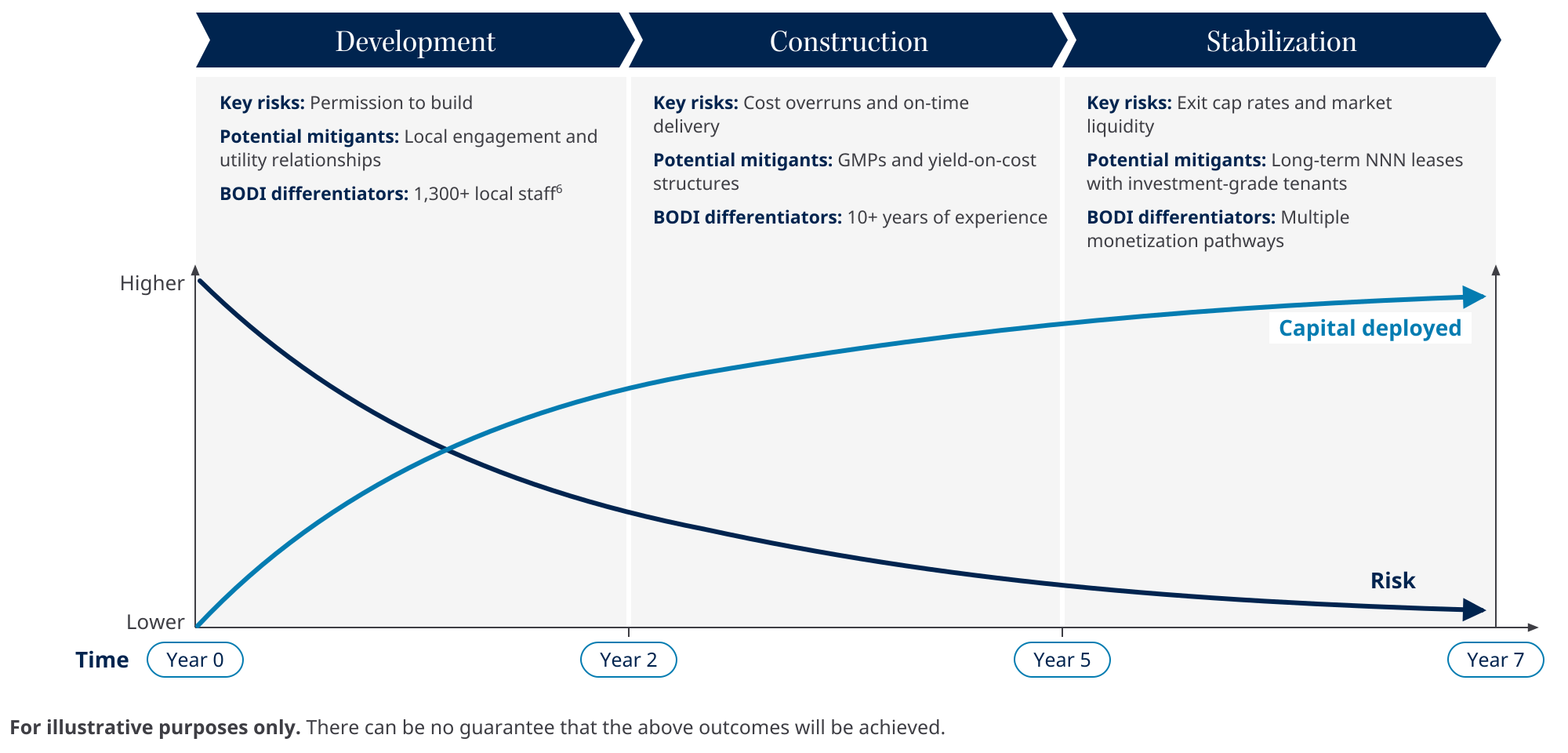
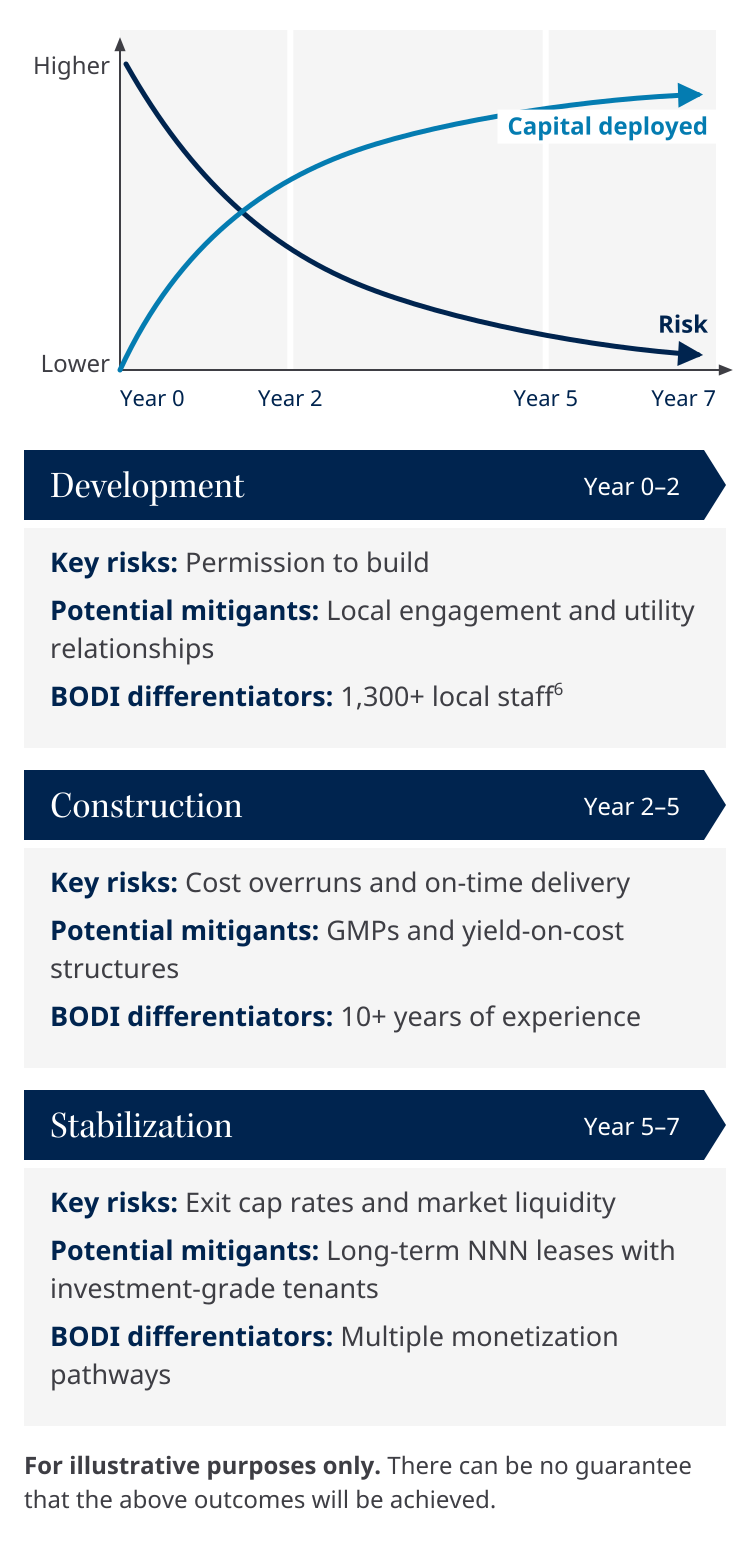
Our strategies primarily focus on stabilized assets and late-stage build-to-suit projects, facilities developed for a specific tenant that are typically leased, entitled, and approved before we commit significant capital. Many of the development risks highlighted by the election results arise before a project receives the necessary approvals to proceed. This is also the phase during which we typically deploy the least capital, approximately 0%–5% of projected costs. We deploy more once zoning, permits, and power are secured and long-term leases with investment-grade or other creditworthy2 tenants are signed.
Permitting, power, and approval risks are not new, and our portfolio companies have long managed them. We do not believe the election changes that. Clearer rules for responsible development, which we welcome, should favor developers that engage communities early and earn approval through transparency and relationship building before breaking ground.
Stabilized assets have already cleared those hurdles. If local restrictions slow new supply, we believe capacity that is built, powered, and leased is well positioned as demand keeps growing.
Local ballot measures may make new data centers harder to build in some communities, but they do not diminish the underlying need for capacity. We believe growing demand and increasing barriers to development reinforce the importance of existing capacity, disciplined execution, and responsible capital deployment — three characteristics central to our investment approach.
Your go-to for an owl’s-eye view on what matters most to us in Private Wealth.
Reach out to member of our Private Wealth team today.
Individual investors, please contact your financial advisor for more information.
Endnotes
1. State Capital Lobbyist, results as of Nov. 5, 2026; unofficial until certified.
2. Company reports, quarters ended Mar. 31–Sept. 30, 2026. Contracted revenue not yet delivered: Google Cloud revenue backlog (~$561B as of Sept. 30, 2026; definition changed in Q1 2026) plus Microsoft commercial remaining performance obligations ($677B). Capital spending: sum of the low end of 2026 guidance for Alphabet, Amazon, Meta, and Microsoft (Microsoft on a calendar-year basis); definitions vary by company. Guidance is subject to change and may not be realized.
3. ITU Facts & Figures, 2025.
4. ITU; Statista, 2025.
5. IDC, “Global DataSphere Forecast, 2026–2030” (Global DataSphere projected to surpass 700 ZB by 2030).
6. Includes employees of STACK Infrastructure, Beale Infrastructure, RadiusDC, Gigabit Fiber, and Kirkwood Infrastructure are Blue Owl Digital Infrastructure’s wholly owned/controlled captive operating companies.
7. A security rating is not a recommendation to buy, sell, or hold securities and may be subject to revision or withdrawal at any time. Investment grade companies must have “BBB-” rating or higher by S&P or an equivalent rating from a nationally recognized statistical rating organization (NRSRO).
Important information
Unless otherwise noted the Report Date referenced herein is as of November 10, 2026.
Past performance is not a guarantee of future results.
The material presented is proprietary information regarding Blue Owl Capital Inc. (“Blue Owl”), its affiliates and investment program, funds sponsored by Blue Owl, including the Blue Owl Credit, Real Assets Funds and the GP Strategic Capital Funds (collectively the “Blue Owl Funds”) as well as investment held by the Blue Owl Funds.
An investment in the Fund or other investment vehicle entails a high degree of risk. Prospective investors should consider all of the risk factors set forth in the "Certain Risk Factors and Actual and Potential Conflicts of Interest" of the PPM or Prospectus, each of which could have an adverse effect on the Fund or other investment vehicle and on the value of Interests.
An investment in the Fund or other investment vehicle is suitable only for sophisticated investors and requires the financial ability and willingness to accept the high risks and lack of liquidity associated with an investment in the Fund or other investment vehicle. Investors in the Fund or other investment vehicle must be prepared to bear such risks for an indefinite period of time. There will be restrictions on transferring interests in the Fund or other investment vehicle, and the investment performance of the Fund or other investment vehicle may be volatile. Investors must be prepared to hold their interests in the Fund or other investment vehicle until its dissolution and should have the financial ability and willingness to accept the risk characteristics of the Fund's or other investment vehicle’s investments.
There can be no assurances or guarantees that the Fund's or other investment vehicles investment objectives will be realized that the Fund's or other investment vehicle investment strategy will prove successful or that investors will not lose all or a portion of their investment in the Fund.
Furthermore, investors should not construe the performance of any predecessor funds or other investment vehicle as providing any assurances or predictive value regarding future performance of the Fund.
The views expressed and, except as otherwise indicated, the information provided are as of the report date and are subject to change, update, revision, verification, and amendment, materially or otherwise, without notice, as market or other conditions change. Since these conditions can change frequently, there can be no assurance that the trends described herein will continue or that any forecasts are accurate. In addition, certain of the statements contained in this material may be statements of future expectations and other forward-looking statements that are based on the current views and assumptions of Blue Owl and involve known and unknown risks and uncertainties (including those discussed below) that could cause actual results, performance, or events to differ materially from those expressed or implied in such statements. These statements may be forward-looking by reason of context or identified by words such as “may, will, should, expects, plans, intends, anticipates, believes, estimates, predicts, potential or continue” and other similar expressions. Neither Blue Owl, its affiliates, nor any of Blue Owl’s or its affiliates' respective advisers, members, directors, officers, partners, agents, representatives or employees or any other person (collectively the “Blue Owl Entities”) is under any obligation to update or keep current the information contained in this document.
This material contains information from third party sources which Blue Owl has not verified. No representation or warranty, express or implied, is given by or on behalf of the Blue Owl Entities as to the accuracy, fairness, correctness or completeness of the information or opinions contained in this material and no liability whatsoever (in negligence or otherwise) is accepted by the Blue Owl Entities for any loss howsoever arising, directly or indirectly, from any use of this material or its contents, or otherwise arising in connection therewith.
All investments are subject to risk, including the loss of the principal amount invested. These risks may include limited operating history, uncertain distributions, inconsistent valuation of the portfolio, changing interest rates, leveraging of assets, reliance on the investment advisor, potential conflicts of interest, payment of substantial fees to the investment advisor and the dealer manager, potential illiquidity, and liquidation at more or less than the original amount invested. Diversification will not guarantee profitability or protection against loss. Performance may be volatile, and the NAV may fluctuate.
offer or a solicitation to sell or subscribe for any fund or other investment vehicle and does not constitute investment, legal, regulatory, business, tax, financial, accounting, or other advice or a recommendation regarding any securities of Blue Owl, of any fund or investment vehicle managed by Blue Owl, or of any other issuer of securities. Only a definitive offering document (i.e.: Prospectus or Private Placement Memorandum or other offering material) can make such an offer.
Copyright© Blue Owl Capital Inc. 2026. All rights reserved. This material is proprietary and may not be reproduced, transferred, or distributed in any form without prior written permission from Blue Owl. It is delivered on an “as is” basis without warranty or liability by accepting the information, you agree to abide by all applicable copyright and other laws, as well as any additional copyright notices or restrictions contained in the information