
Investors today are faced with new challenges, but they also have new opportunities to address them. By expanding core allocations to include investments from the private markets, investors can potentially improve portfolio outcomes from both a risk and return standpoint.
The 60/40 portfolio dates back to 1952, when Harry Markowitz and William Sharpe created Modern Portfolio Theory. Modern Portfolio Theory is a practical method of selecting investments to maximize returns within an acceptable level of risk which paved the way for the classic blend of 60% public stocks and 40% public bonds. While it has, undoubtedly, helped millions of investors diversify and grow their wealth, this allocation may not be as suitable in the today’s markets.
Why? Because the 60/40 portfolio excludes assets from the private markets that may help investors as they pursue their goals.
Private markets represent a large and growing opportunity – more than 8 in 10 companies in the United States that generate revenues in excess of $100 million are privately held.1 These companies have historically been difficult or impossible for individual investors to invest in as they do not trade on public exchanges.
Supplementing the traditional approach with these assets does not abandon the principles set forth by 60/40 — they may even enhance them. Backed by decades of outperformance, private market assets can serve as powerful tools to diversify return streams, providing ballast to portfolios.
Investors today are faced with new challenges, but they also have new opportunities to address them. By expanding core allocations to include investments from the private markets, investors can potentially improve portfolio outcomes from both a risk and return standpoint when considered in the context of individual objectives and risk tolerance.
In a traditionally diversified portfolio, equity serves a distinct purpose: growth. By allocating to individual public equities or equity funds, investors hope to capture the potential upside of businesses or industry sectors. For decades, this has been the standard.
However, data suggests that private equity has historically produced favorable long‑term return outcomes relative to public equity.2 The delta between private and public equity returns can be substantial, driven by several factors: expanded investment opportunities, hands-on ownership, longer investment horizons, and the premium associated with less liquid assets, to name a few.
While public equities will always remain a staple, the modern portfolio demands a more strategic approach. Broadening a core growth allocation to include private equity may unlock a number of potential benefits: powerful diversification, historically greater returns, and reduced volatility.
Past performance is not a guarantee of future results. An investor cannot invest directly in an index. Index performance does not reflect fees and expenses, which may include management fees, access fund expenses, and administrative fees. The portfolio metrics shown are illustrative and reflect hypothetical asset allocations constructed for analytical purposes only; they do not represent the performance of any actual investment portfolio or fund. An investor cannot invest directly in an index, and index performance does not reflect fees or expenses
In traditional 60/40 portfolio construction, fixed income has an explicit role: generating income and preserving capital. This dual role has made fixed income an indispensable component for investor portfolios. Theoretically, bonds and treasuries provide stability during downturns in equity markets, as predictable income streams can help offset the inherent volatility of equity markets.
However, shifting market dynamics have driven a growing correlation between public equities and bonds — a concerning trend. The fundamental purpose of diversification is to build a portfolio with assets that behave differently under varying market conditions. If equities and bonds move in unison, the conventional benefits of holding bonds are diminished, leaving portfolios more exposed to market swings than investors might anticipate. Consequently, investors should consider looking outside the traditional suite of public debt to generate the income they need to pursue their financial goals.
Private credit may be a compelling substitute. Strategies in this asset class have historically been associated with return streams driven largely by income. Private loans may also be positioned to support capital preservation, especially in tumultuous markets, with features like loan structures, selective sourcing, vigorous diligence processes, and direct involvement from managers in workout situations.
In today’s market, with correlations between public fixed income and equities on the rise, investors need solutions that can bring balance to an income allocation. By strategically shifting from public debt to private credit, investors could build portfolios with increased diversification and higher current income.
Past performance is not a guarantee of future results. An investor cannot invest directly in an index. Index performance does not reflect fees and expenses, which may include management fees, access fund expenses, and administrative fees. The portfolio metrics shown are illustrative and reflect hypothetical asset allocations constructed for analytical purposes only; they do not represent the performance of any actual investment portfolio or fund. An investor cannot invest directly in an index, and index performance does not reflect fees or expenses
The classic view of a balanced portfolio makes a notable omission: real estate. Institutional investors have been historically drawn to the asset class, and for good reason – real estate can provide diversification benefits and attractive risk-adjusted returns. In inflationary environments, real estate strategies become even more compelling. Inflation can cause property values and rents to escalate, positioning real estate as a natural hedge against pricing pressures.
Real estate investments accessed via public markets can experience volatility, often influenced by factors that may be less directly related to the fundamentals of the underlying assets. Investments in private real estate may help reduce exposure to public market swings and offer potential advantages associated with manager control. Through direct ownership, asset managers may influence strategic decisions, helping actively manage properties, optimize rental rates, and advise on acquisitions and dispositions.
Private real estate strategies, which can be funded from either a growth or an income allocation depending on investment goals, can provide portfolios with a differentiated return stream. The income produced by private real estate can also benefit from favorable tax treatment, potentially enhancing investors’ after-tax effective yield.
When constructing portfolios, investors require versatile strategies that can navigate the constantly shifting conditions of the modern market. Private real estate may bring that resilience to portfolios by aiming to generate tax-advantaged income, reducing volatility, and providing insulation from inflation.
Past performance is not a guarantee of future results. An investor cannot invest directly in an index. Index performance does not reflect fees and expenses, which may include management fees, access fund expenses, and administrative fees. The portfolio metrics shown are illustrative and reflect hypothetical asset allocations constructed for analytical purposes only; they do not represent the performance of any actual investment portfolio or fund. An investor cannot invest directly in an index, and index performance does not reflect fees or expenses
When investors incorporate private market assets into a traditional portfolio of stocks and bonds, they're not simply adding new asset classes — they're seeking to facilitate specific investment outcomes. Diversifying across multiple strategies, each with their own sources of returns, can further amplify the potential benefits. Private equity, private credit, and private real estate introduce unique characteristics that, when integrated properly, can refine a portfolio's performance profile.
Moreover, employing multiple strategies can reduce the impact of unexpected market shocks, as the overall portfolio is less likely to be concentrated in a certain sector or geography. While one strategy faces headwinds, another may capture growth, and yet another might provide steady income. The result is a portfolio that is less reliant on the performance of any single market or economic condition and more resilient to the fluctuations of the global economy.
Past performance is not a guarantee of future results. An investor cannot invest directly in an index. Index performance does not reflect fees and expenses, which may include management fees, access fund expenses, and administrative fees. The portfolio metrics shown are illustrative and reflect hypothetical asset allocations constructed for analytical purposes only; they do not represent the performance of any actual investment portfolio or fund. An investor cannot invest directly in an index, and index performance does not reflect fees or expenses.
In order to understand how a diversified portfolio featuring private market assets can potentially impact investor outcomes, it can be helpful to look back at how these illustrative allocations have behaved over longer periods, including times of turbulence in public markets and subsequent recoveries.
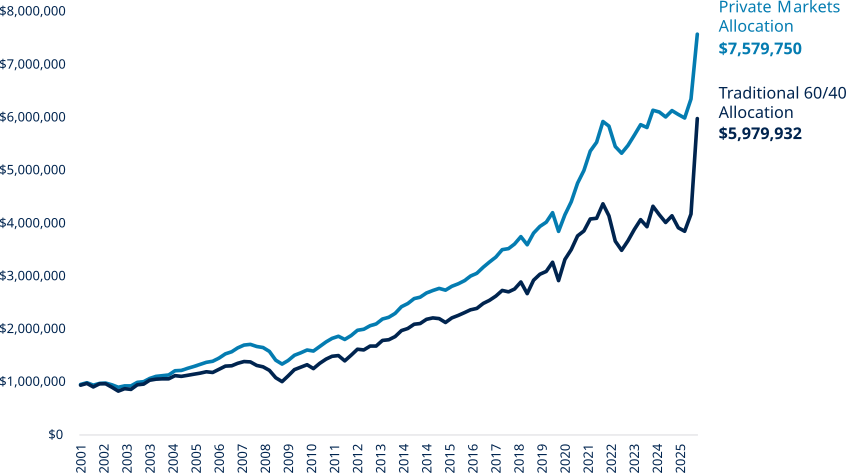
Past performance is not a guarantee of future results. This illustration applies historical index returns to static, illustrative allocations for educational purposes. It is intended to provide context around how different asset allocations have behaved across market environments and does not represent the performance of any actual investment portfolio or fund
Private market assets can help investors seek more consistent, predictable returns — effectively preparing portfolios for whatever the market throws at them. That said, it's essential to navigate alternatives with a clear understanding of their investment profile.
They typically require a commitment to longer time horizons, a trade-off for the potential of higher returns and lower volatility. Therefore, investors must evaluate their liquidity needs, ensuring they have sufficient access to capital for both planned expenditures and unforeseen circumstances. A thoughtful allocation to private markets should strike a balance between these assets with more liquid investments to maintain overall portfolio flexibility. However, investors may find that they do not require 100% liquidity, 100% of the time.
Investors must also consider how private market investments align with their broader financial goals and risk tolerance. The diversification benefits of private markets can be substantial, but they must be integrated into a portfolio in a way that complements an investor's overall strategy.
As with any investment, investors have several choices to make when evaluating an allocation to private markets. Choosing the right manager is among the most important. Managers rely on deep industry knowledge, partnerships, and experience to unlock value for their investors. Asset managers should possess a demonstrated track record, domain expertise, and transparent investment strategies.
Further, the asset manager's philosophy should resonate with the investor's own objectives, whether that be growth, income generation, capital preservation, inflation protection, or a combination of them all.
Modern Portfolio Theory helped create a roadmap for investors to construct balanced portfolios in pursuit of their individual goals, but the challenges of today are different from those of the past – portfolios should be different, too. By including assets beyond public equities and bonds, investors can capture the opportunity for improved risk-adjusted returns with private markets.
Endnotes
Your go-to for an owl’s-eye view on what matters most to us in Private Wealth.
Important information
Unless otherwise noted the Report Date referenced herein is as of November 30. 2025.
Past performance is not a guarantee of future results.
Assets Under Management (“AUM”) refers to the assets that we manage and is generally equal to the sum of (i) net asset value (“NAV”); (ii) drawn and undrawn debt; (iii) uncalled capital commitments; (iv) total managed assets for certain Credit and Real Assets products; and (v) par value of collateral for collateralized loan obligations (“CLOs”) and other securitizations.
The webpage presented is proprietary information regarding Blue Owl Capital Inc. (“Blue Owl”), its affiliates and investment program, funds sponsored by Blue Owl, including the Blue Owl Credit, Real Assets Funds and the GP Strategic Capital Funds (collectively the “Blue Owl Funds”) as well as investment held by the Blue Owl Funds.
An investment in the Fund or other investment vehicle entails a high degree of risk. Prospective investors should consider all the risk factors set forth in the "Certain Risk Factors and Actual and Potential Conflicts of Interest" of the PPM or Prospectus, each of which could have an adverse effect on the Fund or other investment vehicle and on the value of Interests.
An investment in the Fund or other investment vehicle is suitable only for sophisticated investors and requires the financial ability and willingness to accept the high risks and lack of liquidity associated with an investment in the Fund or other investment vehicle. Investors in the Fund or other investment vehicle must be prepared to bear such risks for an indefinite period of time. There will be restrictions on transferring interests in the Fund or other investment vehicle, and the investment performance of the Fund or other investment vehicle may be volatile. Investors must be prepared to hold their interests in the Fund or other investment vehicle until its dissolution and should have the financial ability and willingness to accept the risk characteristics of the Fund's or other investment vehicle’s investments.
There can be no assurances or guarantees that the Fund's or other investment vehicles investment objectives will be realized that the Fund's or other investment vehicle investment strategy will prove successful or that investors will not lose all or a portion of their investment in the Fund.
Furthermore, investors should not construe the performance of any predecessor funds or other investment vehicle as providing any assurances or predictive value regarding future performance of the Fund.
The views expressed and, except as otherwise indicated, the information provided are as of the report date and are subject to change, update, revision, verification, and amendment, materially or otherwise, without notice, as market or other conditions change. Since these conditions can change frequently, there can be no assurance that the trends described herein will continue or that any forecasts are accurate. In addition, certain of the statements contained in this webpage may be statements of future expectations and other forward-looking statements that are based on the current views and assumptions of Blue Owl and involve known and unknown risks and uncertainties (including those discussed below) that could cause actual results, performance, or events to differ materially from those expressed or implied in such statements. These statements may be forward-looking by reason of context or identified by words such as “may, will, should, expects, plans, intends, anticipates, believes, estimates, predicts, potential or continue” and other similar expressions. Neither Blue Owl, its affiliates, nor any of Blue Owl’s or its affiliates' respective advisers, members, directors, officers, partners, agents, representatives or employees or any other person (collectively the “Blue Owl Entities”) is under any obligation to update or keep current the information contained in this webpage.
This webpage contains information from third party sources which Blue Owl has not verified. No representation or warranty, express or implied, is given by or on behalf of the Blue Owl Entities as to the accuracy, fairness, correctness or completeness of the information or opinions contained in this webpage and no liability whatsoever (in negligence or otherwise) is accepted by the Blue Owl Entities for any loss howsoever arising, directly or indirectly, from any use of this webpage or its contents, or otherwise arising in connection therewith.
All investments are subject to risk, including the loss of the principal amount invested. These risks may include limited operating history, uncertain distributions, inconsistent valuation of the portfolio, changing interest rates, leveraging of assets, reliance on the investment advisor, potential conflicts of interest, payment of substantial fees to the investment advisor and the dealer manager, potential illiquidity, and liquidation at more or less than the original amount invested. Diversification will not guarantee profitability or protection against loss. Performance may be volatile, and the NAV may fluctuate.
This webpage is for informational purposes only and is not an offer or a solicitation to sell or subscribe for any fund or other investment vehicle and does not constitute investment, legal, regulatory, business, tax, financial, accounting, or other advice or a recommendation regarding any securities of Blue Owl, of any fund or investment vehicle managed by Blue Owl, or of any other issuer of securities. Only a definitive offering document (i.e.: Prospectus or Private Placement Memorandum or other offering material) can make such an offer. Neither the Securities and Exchange Commission, the Attorney General of the State of New York nor any state securities commission has approved or disapproved of these securities or determined if the Prospectus, Private Placement Memorandum or other offering material is truthful or complete. Any representation to the contrary is a criminal offense. Within the United States and Canada, securities are offered through Blue Owl Securities LLC, member of FINRA/SIPC, as Dealer Manager.
Copyright© Blue Owl Capital Inc. 2026. All rights reserved. This presentation is proprietary and may not be reproduced, transferred, or distributed in any form without prior written permission from Blue Owl. It is delivered on an “as is” basis without warranty or liability by accepting the information, you agree to abide by all applicable copyright and other laws, as well as any additional copyright notices or restrictions contained in the information.