Institutions have long benefitted from access to private markets, as private investments have helped to enhance diversification, reduce volatility, and historically outperform their public equivalents over time.1
often as much as $10 million
due to infrequent performance reporting
resulting from long lock-up periods
The narrative is changing though. As demand from individual investors to allocate to private market strategies has increased, so too has the level of access. The evolution of fund structures, updates to regulation, and a proliferation of managers entering the private wealth space have collectively lowered these barriers for individual investors.
Private asset managers have made innovations to fund structures, developing and launching a vehicle intended to be more investor‑friendly for private markets — the evergreen fund. With lower minimums, greater transparency, and evolved liquidity features, evergreen funds (sometimes referred to as perpetual funds or open-end funds) create a modern access point for individual investors.
Unlike the closed-end structure of traditional private market funds, which typically locks up investor capital for a set number of years, evergreen funds don’t have fixed terms. Instead, this structure enables managers to continuously raise and deploy capital, allowing for ongoing investment and redemption cycles that can align better with the liquidity needs of individual investors.
|
GP/LP (Alts 1.0) |
Evergreen funds (Alts 2.0) |
Mutual funds |
|
|---|---|---|---|
|
Cell label
Structure |
Cell label
Closed-end, limited partnership |
Cell label
Open-end |
Cell label
Open-end |
|
Cell label
Investor eligibility |
Cell label
Varies, may include Qualified Purchasers and Accredited Investors depending on structure |
Cell label
Varies, may include Accredited and non-accredited investors depending on structure |
Cell label
Any investor |
|
Cell label
Investment minimum |
Cell label
Varies, typically starting at $5 million |
Cell label
Varies; evolving access points rather than fixed minimums |
Cell label
Varies; evolving access points rather than fixed minimums |
|
Cell label
Pricing |
Cell label
Quarterly |
Cell label
Typically quarterly or monthly NAV/pricing |
Cell label
Daily |
|
Cell label
Performance reporting |
Cell label
Closed-end, limited partnership |
Cell label
Typically quarterly or monthly |
Cell label
Typically quarterly or monthly |
|
Cell label
Capital deployment / funding |
Cell label
Multi-year commitment |
Cell label
Immediate deployment upon investment |
Cell label
Immediate deployment upon investment |
|
Cell label
Liquidity |
Cell label
None, typically 10-year lock-up period |
Cell label
Periodic, typically quarterly and subject to gates, notice periods, or other limits (may vary by product) |
Cell label
Daily |
|
Cell label
Tax reporting |
Cell label
K-1 |
Cell label
1099 |
Cell label
1099 |
|
Cell label
Fund life |
Cell label
Typically, 10 or more years |
Cell label
Indefinite |
Cell label
Indefinite |
Past performance is not indicative of future results. There can be no assurance that historical trends will continue.
For illustrative purposes only. Features may vary by products and are not representative of any specific investment offering. This information is not intended as a recommendation or endorsement of any particular investment type
The liquidity of alternative strategies, like any investment, has two dimensions: the liquidity of the underlying assets in which the strategy invests and the liquidity terms of the vehicle structure itself.
Private assets are illiquid in nature. They not only have longer investment horizons in order to maximize value creation but are also subject to different transaction dynamics — selling a stake in a private company or property may involve negotiations that can take months to close. Consequently, investor capital is not readily accessible in a traditional private fund. Evergreen funds, on the other hand, make it possible for individuals to invest in illiquid assets while offering periodic liquidity features, subject to the structure’s parameters.
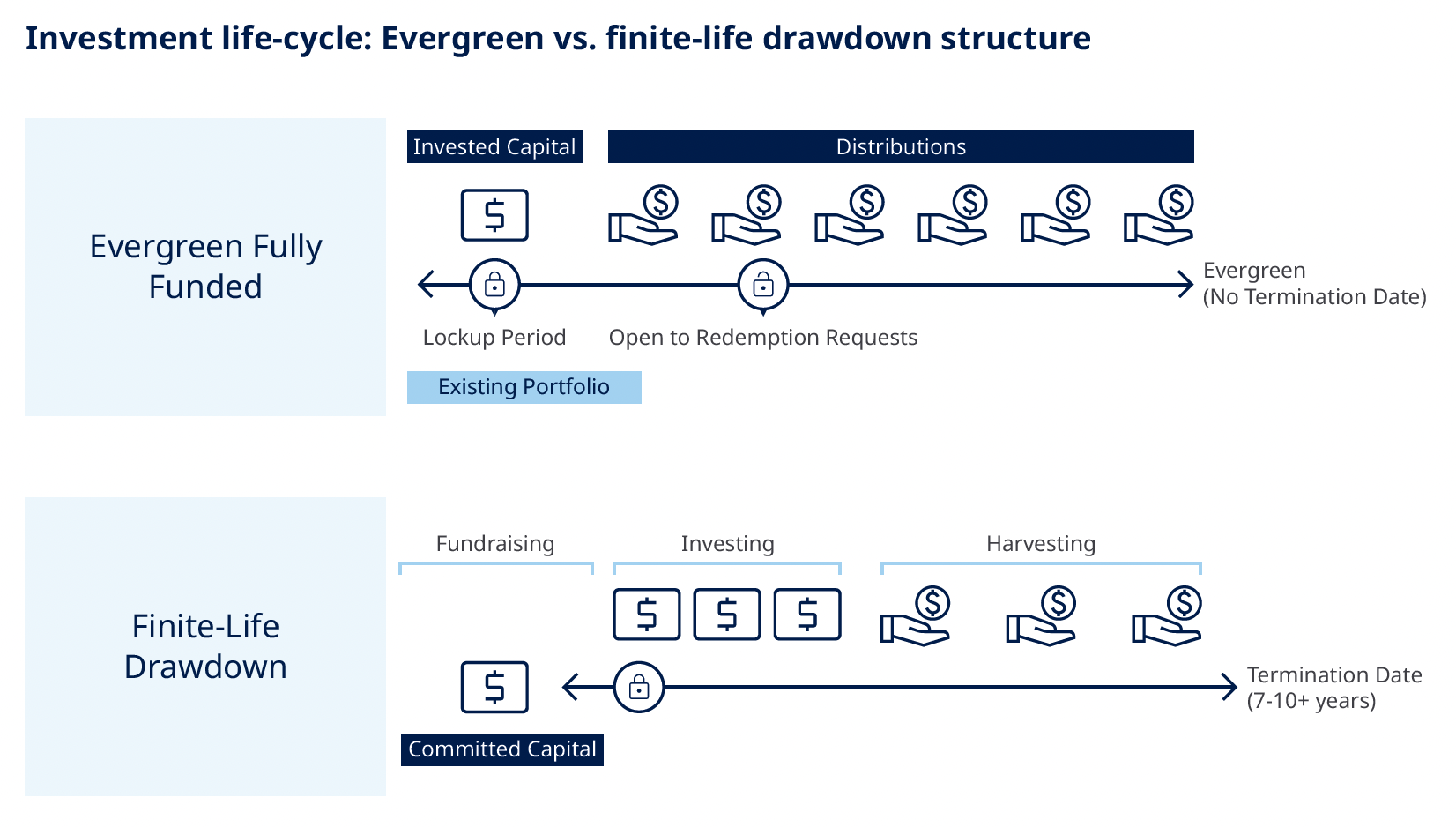
For illustrative purposes only. This comparison is a conceptual summary and may not reflect the precise characteristics, liquidity features, or timelines of any particular evergreen or drawdown structure. Actual structures vary.
When considering allocations to private markets, investors should weigh trading off daily liquidity in exchange for the potential of enhanced returns and reduced volatility. Many investors, particularly those with longer time horizons, may find that they do not require their portfolios to have 100% liquidity, 100% of the time.
Recent years have seen a great number of alternative asset managers create products designed for individual investors, creating even more access points. For investors evaluating allocation to the private markets, selecting the right manager is of critical importance. The role of the manager extends beyond investment diligence and selection. Unlike many public‑market strategies, where the level of direct oversight can vary, private‑market managers typically maintain more hands‑on influence over their investments. They work closely with portfolio companies and assets, implement complex and customized investment strategies, navigate intricate regulatory and operational environments, and deliver a more integrated, end‑to‑end experience for investors.
Institutions and private wealth advisors agree, the experience and track record of the fund manager are the most important things to consider while conducting due diligence on a private market investment.2 The dispersion between performance of top and bottom quartile managers is far greater in private markets vs. public markets – manager selection can lead to significant differences in performance.3
Investors should evaluate an asset manager’s historical performance, investment philosophy, and operational capabilities to gain insight into how the manager has approached identifying and executing on investment opportunities over time.
While a manager’s track record of performance is, of course, an extremely important piece of the puzzle, their track record of client service cannot be overlooked either. An asset manager is expected to guide investors through their journey, providing educational resources, assisting with onboarding experience, and offering continued service from operations and administration to transparency in performance reporting. Consequently, investors should also vet managers based on their commitment to broadening access and improving the investor experience.
For investors whose objectives align with private‑market strategies, investing in private markets is not cumbersome as it once was. With the right manager, individuals can tap into the same sophisticated strategies that institutional investors have long leveraged in pursuit of greater returns, diversification, and stability.
The bridge has been built, it’s now up to individual investors to cross it.
Endnotes
Your go-to for an owl’s-eye view on what matters most to us in Private Wealth.
Important information
Unless otherwise noted the Report Date referenced herein is as of December 2025.
Past performance is not a guarantee of future results.
Assets Under Management (“AUM”) refers to the assets that we manage and is generally equal to the sum of (i) net asset value (“NAV”); (ii) drawn and undrawn debt; (iii) uncalled capital commitments; (iv) total managed assets for certain Credit and Real Assets products; and (v) par value of collateral for collateralized loan obligations (“CLOs”) and other securitizations.
The webpage presented is proprietary information regarding Blue Owl Capital Inc. (“Blue Owl”), its affiliates and investment program, funds sponsored by Blue Owl, including the Blue Owl Credit, Real Assets Funds and the GP Strategic Capital Funds (collectively the “Blue Owl Funds”) as well as investment held by the Blue Owl Funds.
An investment in the Fund or other investment vehicle entails a high degree of risk. Prospective investors should consider all the risk factors set forth in the "Certain Risk Factors and Actual and Potential Conflicts of Interest" of the PPM or Prospectus, each of which could have an adverse effect on the Fund or other investment vehicle and on the value of Interests.
An investment in the Fund or other investment vehicle is suitable only for sophisticated investors and requires the financial ability and willingness to accept the high risks and lack of liquidity associated with an investment in the Fund or other investment vehicle. Investors in the Fund or other investment vehicle must be prepared to bear such risks for an indefinite period of time. There will be restrictions on transferring interests in the Fund or other investment vehicle, and the investment performance of the Fund or other investment vehicle may be volatile. Investors must be prepared to hold their interests in the Fund or other investment vehicle until its dissolution and should have the financial ability and willingness to accept the risk characteristics of the Fund's or other investment vehicle’s investments.
There can be no assurances or guarantees that the Fund's or other investment vehicles investment objectives will be realized that the Fund's or other investment vehicle investment strategy will prove successful or that investors will not lose all or a portion of their investment in the Fund.
Furthermore, investors should not construe the performance of any predecessor funds or other investment vehicle as providing any assurances or predictive value regarding future performance of the Fund.
The views expressed and, except as otherwise indicated, the information provided are as of the report date and are subject to change, update, revision, verification, and amendment, materially or otherwise, without notice, as market or other conditions change. Since these conditions can change frequently, there can be no assurance that the trends described herein will continue or that any forecasts are accurate. In addition, certain of the statements contained in this webpage may be statements of future expectations and other forward-looking statements that are based on the current views and assumptions of Blue Owl and involve known and unknown risks and uncertainties (including those discussed below) that could cause actual results, performance, or events to differ materially from those expressed or implied in such statements. These statements may be forward-looking by reason of context or identified by words such as “may, will, should, expects, plans, intends, anticipates, believes, estimates, predicts, potential or continue” and other similar expressions. Neither Blue Owl, its affiliates, nor any of Blue Owl’s or its affiliates' respective advisers, members, directors, officers, partners, agents, representatives or employees or any other person (collectively the “Blue Owl Entities”) is under any obligation to update or keep current the information contained in this webpage.
This webpage contains information from third party sources which Blue Owl has not verified. No representation or warranty, express or implied, is given by or on behalf of the Blue Owl Entities as to the accuracy, fairness, correctness or completeness of the information or opinions contained in this webpage and no liability whatsoever (in negligence or otherwise) is accepted by the Blue Owl Entities for any loss howsoever arising, directly or indirectly, from any use of this webpage or its contents, or otherwise arising in connection therewith.
All investments are subject to risk, including the loss of the principal amount invested. These risks may include limited operating history, uncertain distributions, inconsistent valuation of the portfolio, changing interest rates, leveraging of assets, reliance on the investment advisor, potential conflicts of interest, payment of substantial fees to the investment advisor and the dealer manager, potential illiquidity, and liquidation at more or less than the original amount invested. Diversification will not guarantee profitability or protection against loss. Performance may be volatile, and the NAV may fluctuate.
This webpage is for informational purposes only and is not an offer or a solicitation to sell or subscribe for any fund or other investment vehicle and does not constitute investment, legal, regulatory, business, tax, financial, accounting, or other advice or a recommendation regarding any securities of Blue Owl, of any fund or investment vehicle managed by Blue Owl, or of any other issuer of securities. Only a definitive offering document (i.e.: Prospectus or Private Placement Memorandum or other offering material) can make such an offer. Neither the Securities and Exchange Commission, the Attorney General of the State of New York nor any state securities commission has approved or disapproved of these securities or determined if the Prospectus, Private Placement Memorandum or other offering material is truthful or complete. Any representation to the contrary is a criminal offense. Within the United States and Canada, securities are offered through Blue Owl Securities LLC, member of FINRA/SIPC, as Dealer Manager.
Copyright© Blue Owl Capital Inc. 2026. All rights reserved. This presentation is proprietary and may not be reproduced, transferred, or distributed in any form without prior written permission from Blue Owl. It is delivered on an “as is” basis without warranty or liability by accepting the information, you agree to abide by all applicable copyright and other laws, as well as any additional copyright notices or restrictions contained in the information